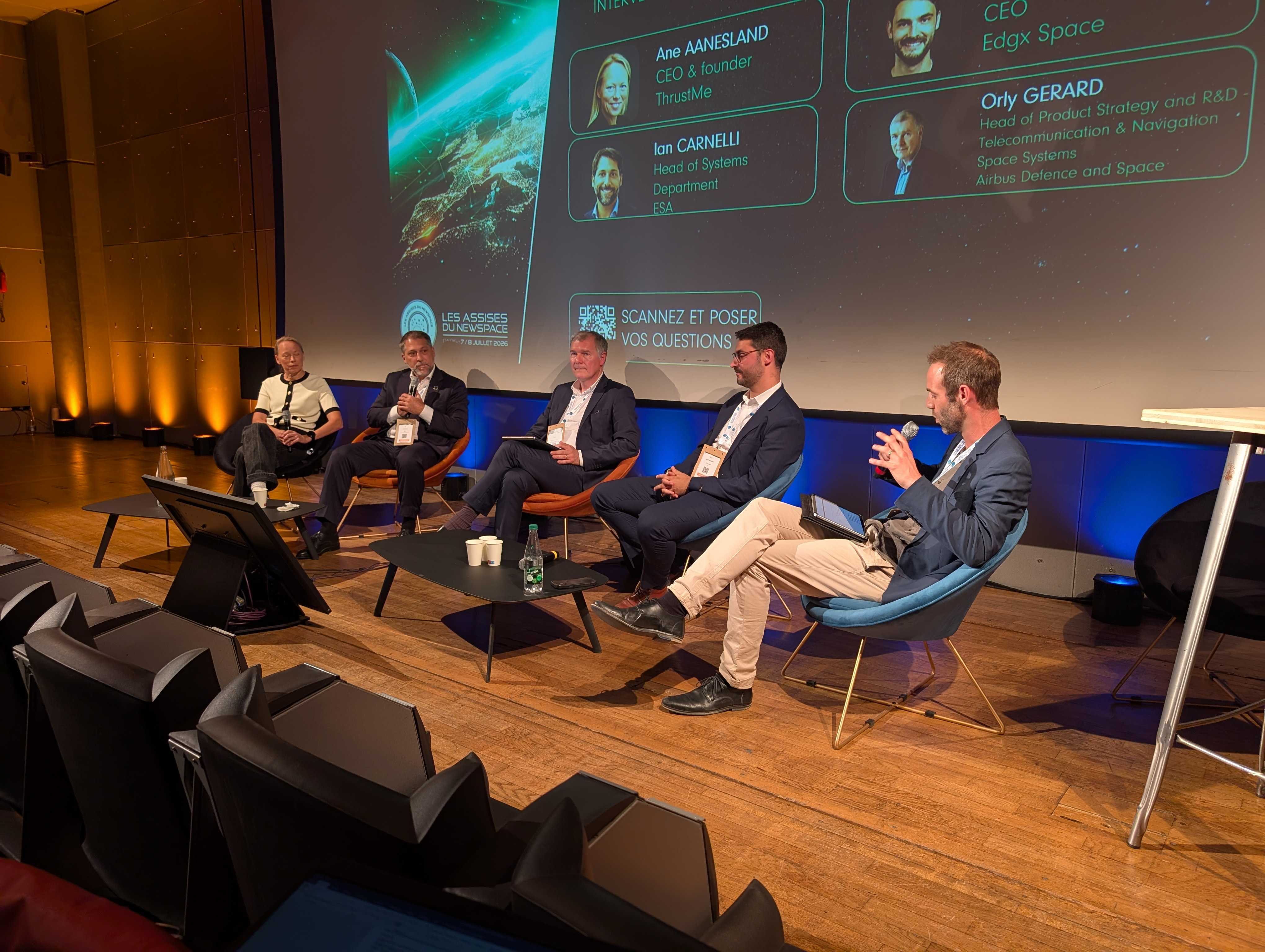
I moderated a roundtable this month on the industrial challenge facing European NewSpace companies: how do you scale production without the process collapsing under its own volume. On stage with me were Ane Aanesland (CEO, ThrustMe), Ian Carnelli (Head of Systems Department, ESA), Nick Destrycker (CEO, EDGX), and Olry Gerard (Head of Product Strategy and R&D, Telecommunication and Navigation Space Systems, Airbus Defence and Space). Four different vantage points on the same supply chain, and one finding all four kept circling back to: the process that works at low rate does not survive volume. Olry's own number from Airbus's OneWeb program makes the point starkly: a line that ran at 2 satellites a year had to reach 20 a month.
Why paper breaks first
Nick's wake-up call was being handed a document 300 to 400 pages long to sign. That was the moment he decided paper had to go, and that EDGX would start industrializing early rather than wait until scale forced the issue.
Olry sees the same failure from the other side of the supply chain. Airbus has to deliver on time, to spec, every time, and that means depending on suppliers who master their own production capacity well enough to catch problems before they become late deliveries. He has watched programs stall on the simplest components, not the hardest ones.
Ane's fix at ThrustMe was to treat production as a day-one design constraint instead of a downstream problem. The company tested in orbit early and ran agile, sprint-based hardware development, keeping production in view at every stage. That is a different posture than most of the industry took a few years ago.
Industrializing is a mindset shift before it is a tooling shift
Ian frames the core problem as ESA coming from a world of prototypes and demonstrators, where a stack of custom paperwork per mission means the industrialization conversation starts too late. His shorthand for where the industry needs to go is design for manufacturability: standardized, plug-and-play interfaces, with manufacturing built in from the start rather than bolted on. He also made a point I keep coming back to: no company industrializes alone. The strongest playbooks are coming from automotive, and companies in the Los Angeles space cluster are already hiring straight out of Detroit to get there faster.
Olry's OneWeb program is the clearest before-and-after I have heard described. Airbus had already seeded reuse, modularity, and closer ties between design, procurement, and production years before OneWeb started. OneWeb was the breakthrough that gave engineers room to invent new industrialization processes, pulling in expertise straight from automotive and aerospace suppliers who had already solved high-rate production. The line went from roughly 2 satellites a year to 20 a month. Automation cut manual error first, then digitalization layered on top of that, and Olry's next target is AI that flags what an assembly step needs before it becomes a defect, so fewer decisions depend on one person's judgment. His line from the panel has stayed with me: you do not need the most polished product, you need the one that matches the customer's needs and can actually be produced.
Ane's hardest problem at ThrustMe was never the engineering. It was people. Headcount roughly doubled, and onboarding became the real quality control, since new hires had to hit the same bar as the team that built the company from nothing. An industrial company has to keep running when any one person is out, without making the people who built it feel replaceable. That shift, from startup to scale-up, is real work, and it does not show up on a Gantt chart.
Ian sees a role for ESA in absorbing some of that pressure from outside the company: act as an anchor customer to generate demand, work with the supplier ecosystem to qualify new processes, and fund the move from prototype to product through initiatives that combine financial and technical support. Industrialization is not only a company's problem to solve alone.
Traceability does not get to be the trade-off
Olry's constraint is absolute: once a satellite launches, nobody repairs it. Everything has to be anticipated before flight. That means simple designs with margin for error, traceability kept intact end to end, failures caught early, and every component treated as if it matters, because on a spacecraft, all of them do.
Ian's angle is about where knowledge lives inside a company. Engineers need to stop chasing the most polished part and start designing the one that can actually be manufactured and resupplied from European sources, turning what one expert knows into what the whole company knows.
Nick's answer at EDGX was operational, not aspirational. EDGX runs assembly through Connektica, wired into Odoo as the company's ERP, so shop floor records and business data live in one system instead of two. That is the same problem we built Connektica to solve: production data that used to live in someone's head, or in a binder, now lives in a system the whole company can rely on.
Where this is heading
Rate pressure is not staying at the top of the supply chain. It is already reaching Tier 2 to 4 suppliers who never had to think about MES for space manufacturing before. The primes and the agencies are asking for it. The startups scaling fastest are the ones treating it as a day-one decision, not a fire drill at 20 units a year.
If you are running into this same wall, EDGX's path from a 400-page paper backlog to a working production system is worth reading in full. Read the EDGX case study


.png?width=1200&height=628&name=blog%20-%20What%20Is%20a%20Cloud%20MES%20for%20Aerospace%20%26%20Defense%20Manufacturing%20(1).png)